
Reframing Auto-renew
Designing a Trust-Centered Auto-Renew Conversation Across Channels
Domain: Membership & subscriptions
Surface: Web, mobile app, in-club POS, associate iPad, call center
Focus: Consent, compliance, trust, retention
Role: Senior UX Content Strategist / Conversational Designer
TL;DR
Led content and conversational strategy for Auto-Renew for All — an FTC-mandated compliance overhaul across 5 surfaces with direct revenue and legal exposure
Negotiated a legal compromise that preserved member trust: limited required "cancel" language to one moment while keeping familiar "expiration" language everywhere else
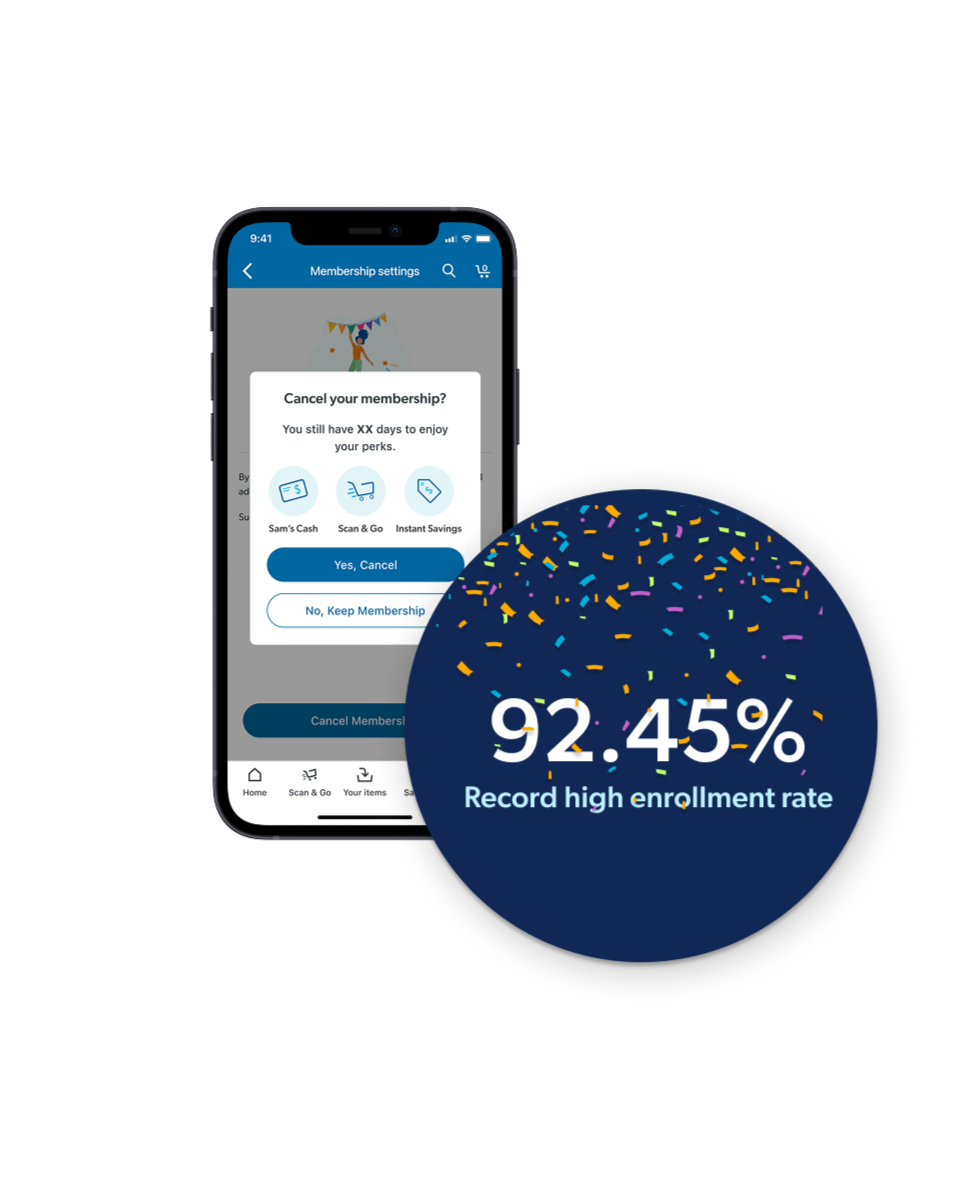
Drove nine-figures in annual incremental revenue, 92.45% record-high enrollment rate, and full FTC compliance.
Earned the Sam's Club Membership Award for my leadership on this project
Summary
Auto-renew became one of the highest-risk touchpoints in the Sam’s Club membership experience. Earlier efforts to increase transparency reduced complaints, but exposed structural issues across enrollment, payment methods, and cancellation that contributed to substantial financial deficit.
At the same time, new FTC regulations following the Amazon “Iliad” lawsuit introduced strict requirements for consent and cancellation. Sam’s Club needed to achieve full compliance across all channels while stabilizing revenue and maintaining member trust in a yearly membership model that did not cleanly map to standard subscription language.
This work carried major legal, financial, and reputational implications. The mandate was: achieve full compliance, stabilize a multi-million-dollar revenue deficit, and don't break the member experience. All three were non-negotiable. My job was to find the version of the system that delivered on all three.
Product Vision
Enable a transparent, member-first automated renewal experience that aligns with member expectations, meets FTC requirements, and increases renewal success through clear consent, consistent language, and predictable system behavior across all channels.
My role
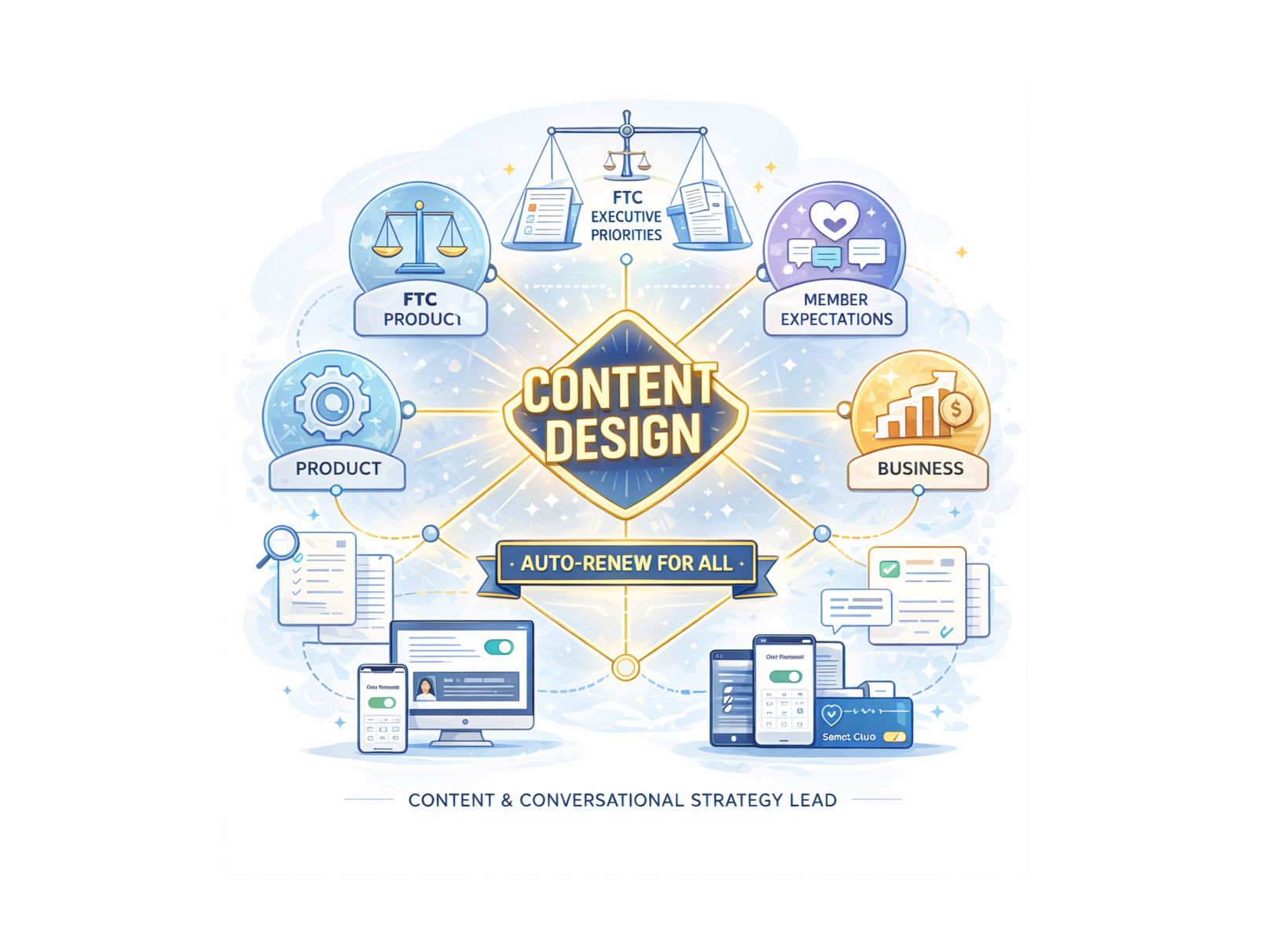
I owned the content system that made auto-renew legally compliant without breaking the member relationship. That meant designing a consent architecture defensible to the FTC, negotiating language carveouts with legal when standard subscription patterns would have damaged trust, and aligning five surfaces (web, mobile, in-club POS, associate iPad, call center) that had never shared a consent model before.
The Approach
Designing consent as a system, not a checkbox
The easy path was friction. Extra screens, required scrolls, confirm-your-cancellation dialogs. These satisfy legal teams because they look visibly compliant, but they're dark patterns in spirit, and the FTC has started treating them that way. I pushed for double-consent enrollment and two-click cancellation built on the opposite principle: a compliant flow should be easier to complete correctly, not harder to escape. Legal signed off. Members got a flow that respected them.
Protecting a 40-year member mental model
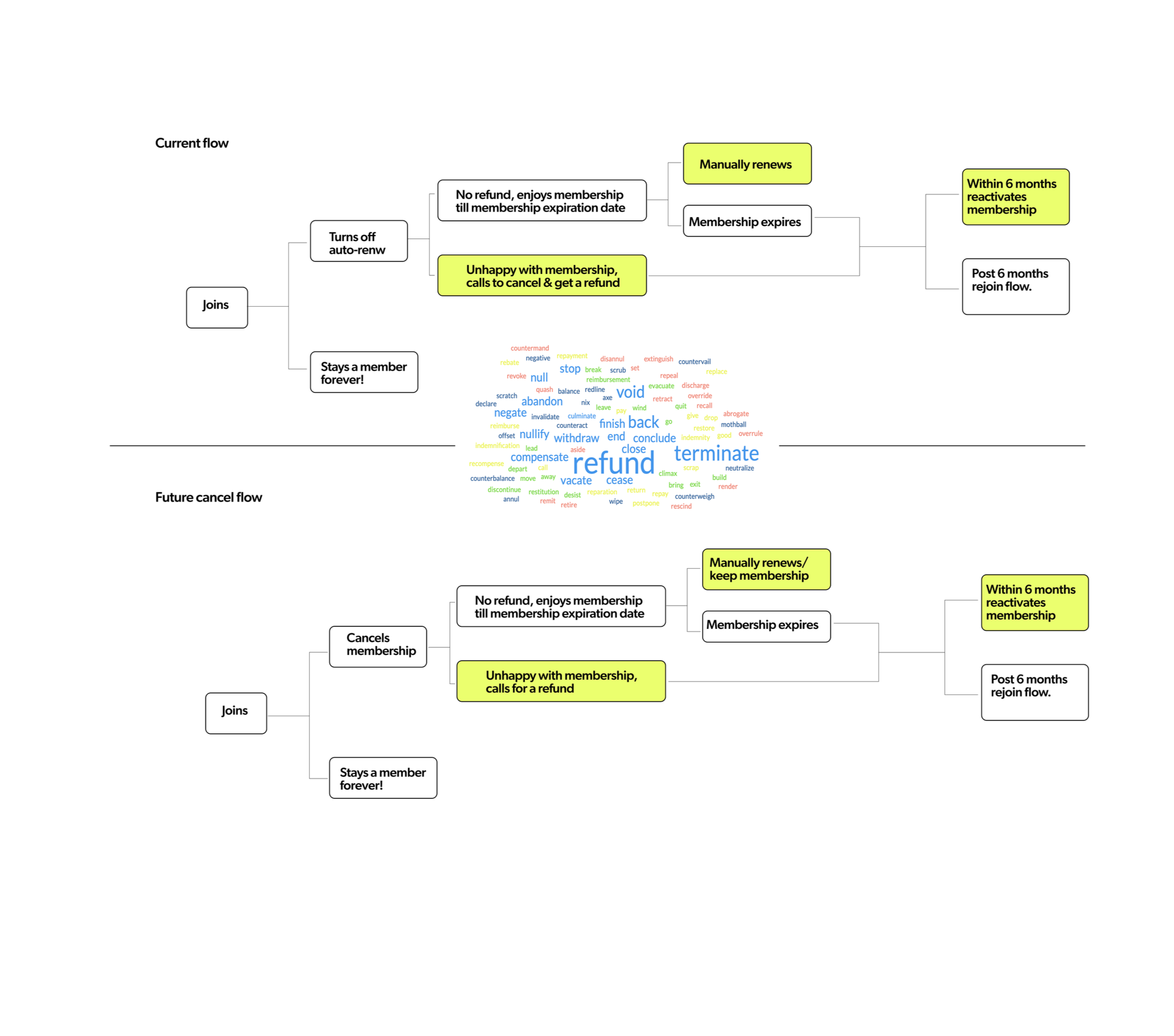
The highest-stakes content decision on the project was a single word: cancel. Our business partner wanted to adopt subscription-economy vocabulary, citing Amazon and Netflix as proof that members understood it. I pushed back, because Amazon and Netflix run monthly subscriptions. Sam's Club runs a yearly membership that had used expiration language for four decades. Adopting "cancel" wholesale would contradict how members already understood their membership, collide with the existing internal use of "cancel" (which meant ending service and issuing a refund), and force us to retrain every member and associate on two new terms at once.
The disagreement escalated to a VP-level meeting between Design and Membership. Loud, direct, unresolved at the close. I held the content position through it, backed by competitive research on the monthly-versus-annual distinction and internal data on how "cancel" was already being used. We landed on a compromise that's held up since: required "cancel" language appears at one specific moment of legal significance, the action of unenrolling. Familiar expiration language stays everywhere else.
Changing how the team talked about ending a membership
The other language battle was internal and quieter. Product and business teams defaulted to terminate in specs, meetings, and copy drafts. Technically accurate, but cold and legalistic, and it would have leaked into member-facing copy without a deliberate choice otherwise. I made the case for deactivate as the team-wide vocabulary. Warmer, reversible-sounding, aligned with how members actually think about pausing a relationship they might resume. The win wasn't just in the copy that shipped. It was getting the team to change how they referred to the concept in their own documents, which meant "terminate" stopped leaking into downstream copy by default.
Stabilizing retention through clarity, not friction
The obvious lever for reducing unenrollment is adding friction to the opt-out path. It works in the short term, but friction erodes trust, and post-Iliad it's also a compliance risk. Instead, I designed a benefits reminder before unenrollment and a post-opt-out confirmation that stated exactly how long benefits would continue. My bet was that most unintended churn came from uncertainty, not determined cancellation. Support volume dropped, unintended churn dropped, and members who chose to leave still left cleanly.
Aligning behavior across channels
Web, mobile app, in-club POS, associate iPad, and call center scripts had each evolved their own language, consent logic, and edge-case handling. Unifying them centrally would have been faster but fragile. One team owning copy for five surfaces creates a bottleneck that breaks under the next regulatory change. I chose distributed adoption instead: shared language standards, a single consent model, governance each surface's team could execute locally. Slower to stand up, durable enough to absorb the next change without rebuilding.
Impact
Contributed to an eight-figure revenue impact from auto-renew changes, driven by a 16-point improvement in transaction success
Delivered multi-million dollar membership growth impact from the broader initiative
92.45% enrollment rate — a record high, up from 83% at the start of FY25
100% auto-enrollment and card capture for members joining in-club at Membership Express
95%+ card-on-file rates; nearly 50% YoY reduction in members without a card on file
Double-digit gains in renewal completion.
Full FTC compliance across all membership paths
Sam's Club Membership Award for leadership on the initiative